Share

In the AI era, finance is the ultimate change agent for the enterprise tech stack. For years, CFOs inherited whatever billing setups product and engineering built up and handed down. Here in 2026, the tough reality of AI unit economics has made reactive finance teams a massive liability for any company. Because AI products incur volatile, real-time compute costs with every transaction, monetization is now even more clearly a direct operational risk to gross margins. To survive, CFOs are being forced to step to the very front of the monetization design process, transforming themselves from passive approvers into the primary architects of any company’s Monetization Operating Model.
As we walk through the transition finance teams are facing, this post will guide you through how today’s finance leaders are asserting control over their margins and turning billing infrastructure into a competitive weapon—whether you're auditing a leaking tech stack or building an AI monetization engine from scratch.
The shift to proactive financial controls
The 2024 AI boom pushed companies towards a primary operating principle: ship fast, bill later. Finance was expected to react, inheriting whatever setup the product team created, and miraculously turn it into a GAAP-compliant revenue report. In 2026, the cost of figuring it out later has become too high.
With autonomous agents capable of scaling usage to millions of events per second, a reactive finance team is a liability. If monetization infrastructure isn't designed with financial controls at its core, a company can go from record growth to margin collapse in a single weekend.
Today’s CFOs have realized that monetization infrastructure is actually a financial risk management tool and are getting involved up front because they, more than anyone else, recognize that a system that provides real-time gross margin visibility is a requirement for the AI era.
CFO as the unit economics lead
While the unit economics conversation once lived in a slide deck that got updated once a quarter, it’s now a live dashboard that drives daily operations. Because AI products carry significant variable costs, CFOs are now the primary stakeholders who make sure that COGS stay aligned with revenue. They’re the ones asking the hard questions during the vendor selection process:
- If we launch a hybrid credit model, how does this tool handle the automated RevRec for unconsumed credits?
- Does this system provide a sub-second kill switch if a customer’s compute costs exceed their prepayment?
- Can we audit the path from a single LLM token to a line item on an invoice?
Engineering and product still have their seats at the table, but their requirements, like uptime and flexibility, are now considered table stakes. The differentiating requirements that actually determine which vendor is chosen are now defined by finance.
Why the budget owner is now the strategic buyer
So why’s this shift happening? CFOs have gone from downstream approver to an early, active role because the billing system isn’t just a way to collect money anymore. It’s now the ledger of truth for the business.
- The compliance mandate
Right now, the regulatory scrutiny on AI revenue is intense. Auditors don’t accept black-box usage estimates anymore, which means that the CFO needs infrastructure that provides an immutable, event-level audit trail. - The speed-to-market paradox
By getting involved earlier, the CFO actually helps product move even faster. When the monetization engine is finance-ready from day one, product can launch new pricing tiers in minutes without waiting for finance to build manual reconciliation processes. - The death of the manual workaround
In the first half of 2025, our Guide to Scaling Finance in AI noted that the spreadsheet workaround died that year. The volume of data in 2026 makes manual billing impossible, so CFOs are buying infrastructure to automate themselves out of the reconciliation trap.
From overlooked in 2025 to essential in 2026
Last year, advice across the industry often focused on how to make sure finance didn't get left behind in this transition. One year later, everything has flipped.
Today’s advice to product managers is clearcut: Don't even bother starting a billing RFP unless your CFO’s requirements in the first paragraph. Finance’s role has been both elevated and fundamentally transformed. CFOs are entering the buying cycle earlier, with a much more technical understanding of infrastructure, and it’s CFOs who are now the ones making the ask for monetization infrastructure. They also are, as they should, getting more and more involved in setting the requirements for the associated tools and processes. So many CFOs we’ve spoken to say that they’ve realized that in the AI era, you have to actually build a financial engine that allows the product to exist—flipping the now-outdated “build a product, then bill for it” process on its head.
The 2026 monetization mandate: A checklist for today’s CFO
If you’re a finance leader evaluating your infrastructure today, it’s probably not news to you that you aren't looking for a simple billing tool anymore. Now, you need a monetization operating system. This checklist can help you determine if your current stack is a legacy anchor slowing you down or a growth engine helping you scale at speed.
- Real-time unit economic visibility
Does the system provide a live view of the gap between usage-driven revenue and the underlying COGS, including inference and compute? You shouldn’t have to wait for a month-end data warehouse sync to see your gross margin. - The audit-ready event ledger
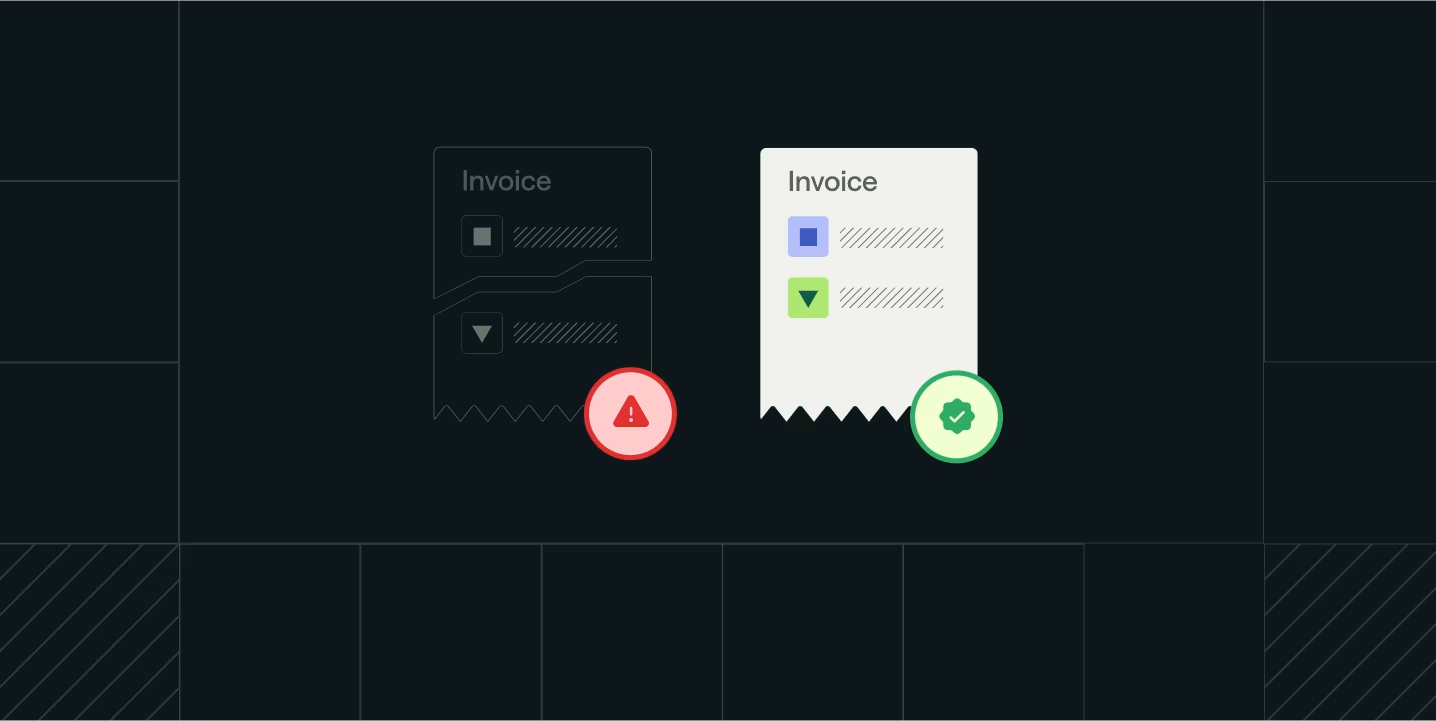
Can you trace an individual line item on a $100k enterprise invoice back to the specific, immutable usage events that generated it? Estimated billing is a massive compliance risk today, and something that can now be avoided with the right infrastructure in place. - Hybrid contract autonomy
Without engineering help, can your team launch a contract that includes a flat subscription fee, a consumption-based credit pool, and a rollover provision for unused tokens? If it requires a sprint to change a contract structure, the system isn’t agile enough for today’s demands. - Automated revenue leakage kill-switches
Does your monetization infrastructure talk back to your product? If a customer's usage spikes 1000% due to a rogue agent, the system should be able to automatically pause the service or trigger an immediate true-up. - Converged data truth
Is finance using the same raw data stream as engineering? If you’re still reconciling two different versions at the end of every month, the core architectural problem still needs to be solved.
Moving forward: The new power center
The center of gravity in the enterprise tech stack has shifted, and the most successful companies in 2026 are those with the most robust financial architectures.
When finance has a decisive seat at the table from the beginning, the result is a flywheel effect:
- Product can experiment with pricing without breaking the books.
- Engineering can scale usage without worrying about margin leakage.
- CFOs can finally stop being the naysaying gatekeeper and start being a key player in the design of monetization who says "here’s how we scale profitably."
Instead of just inheriting the stack, today’s CFOs are building it.